
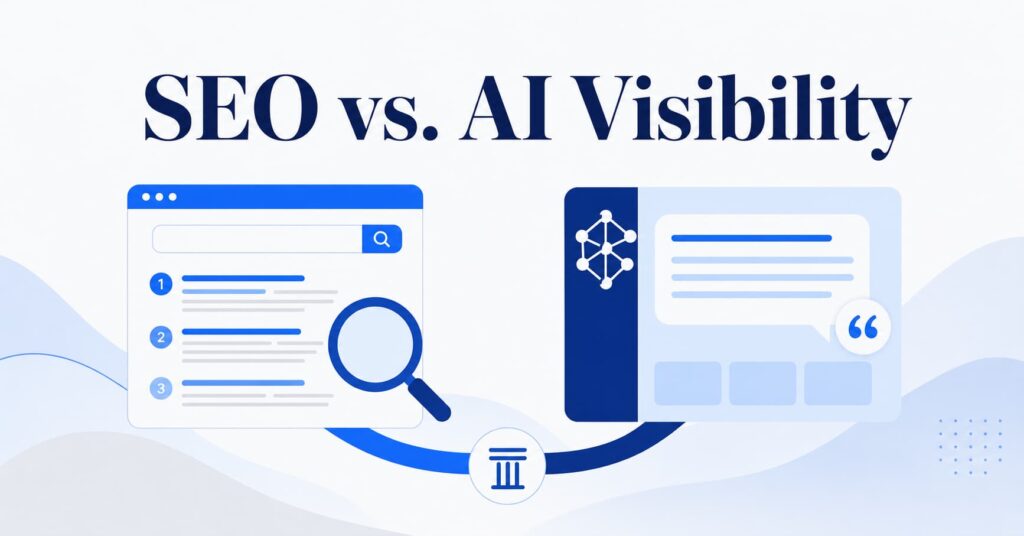
SEO for Search Engines vs. AI Visibility in LLMs: Similarities, Differences, and Best Practices
Key Takeaways
- Traditional SEO optimises for SERP rank and clicks; AI visibility (GEO/AEO) optimises for being cited or synthesised inside AI-generated answers.
- Both rely on the same foundation: crawlable, technically sound, authoritative content — AI visibility doesn’t replace SEO fundamentals; it builds on them.
- SEO competes for one #1 spot per query; AI visibility is non-zero-sum — multiple sources can be cited in the same answer.
- Answer-first formatting, clear entity definitions, and cross-source corroboration (brand mentions, not just backlinks) are the highest-leverage AI visibility tactics.
- No technique guarantees citation by any AI system — the goal is maximising the odds of being treated as a trustworthy, extractable source.
1. Introduction: Two Search Paradigms, One Discoverability Challenge
Search engine optimization (SEO) and AI visibility — often called Generative Engine Optimization (GEO) or Answer Engine Optimization (AEO) — are two distinct but related disciplines for making content discoverable. SEO optimises content to rank in traditional search engine results pages (SERPs) such as Google and Bing. AI visibility optimises content so that large language models (LLMs) such as ChatGPT, Claude, Gemini, and Perplexity can retrieve, synthesise, and cite it when generating direct answers to user queries.
Traditional SEO is the practice of improving a website’s technical structure, content, and authority so it ranks higher in search engine results for relevant queries, driving organic click-through traffic.
AI Visibility (GEO/AEO) is the practice of structuring content so that AI systems can accurately extract, synthesise, and attribute it when generating a direct answer, rather than simply linking to it.
1.1 Why This Comparison Matters in 2026
Search behaviour has fragmented. A growing share of informational queries are now answered directly inside AI interfaces — Google’s AI Overviews, ChatGPT, Perplexity, and Gemini — without a click to any website. This shifts the unit of success from “rank #1” to “get cited, mentioned, or synthesised into the answer.” Businesses that optimize only for classic SERP rankings risk losing visibility in this new layer of search, even while their traditional rankings hold steady.
1.2 Quick Definitions: Traditional SEO vs. AI Visibility
| Concept | Traditional SEO | AI Visibility (GEO/AEO) |
|---|---|---|
| Goal | Rank in SERP | Get cited/synthesized in an AI answer |
| Unit of success | Position (#1–10) | Citation frequency, share of voice |
| Primary consumer | Search engine crawler + human reader | LLM retrieval system + generated answer |
| Output surface | List of blue links | Direct, synthesised answer |
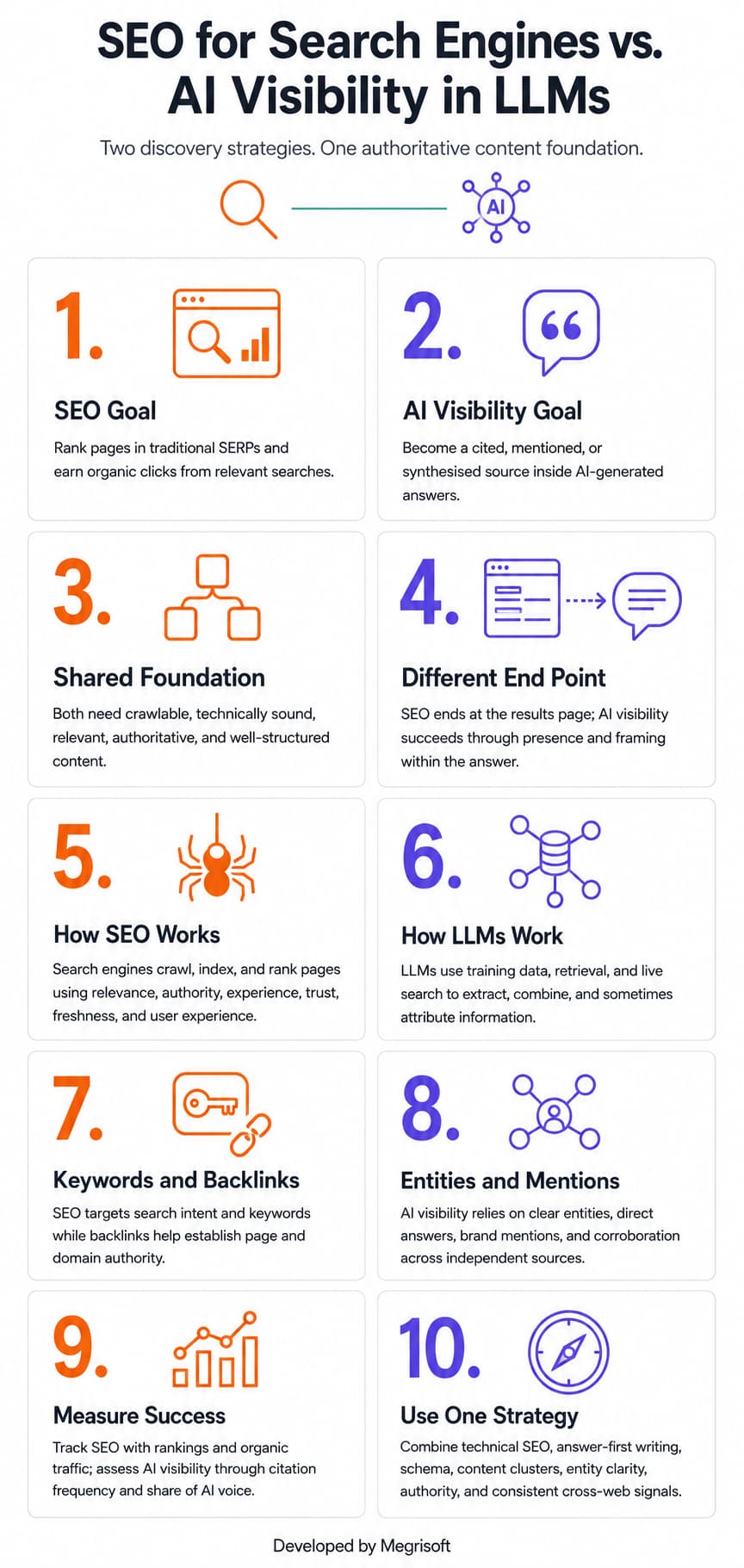
A visual comparison of traditional search engine SEO and AI visibility in large language models.
2. What Is Traditional SEO?
Traditional SEO is the set of practices used to increase a website’s visibility in organic (unpaid) search engine results. It rests on three pillars: technical accessibility, content relevance, and authority.
2.1 Core Mechanics: Crawling, Indexing, Ranking
Search engines operate in three stages:
- Crawling — bots (e.g., Googlebot) discover pages by following links and sitemaps.
- Indexing — the engine stores and categorises page content to determine what the page is “about.”
- Ranking — for a given query, the engine scores indexed pages against hundreds of signals and returns an ordered list of results.
2.2 Ranking Signals Search Engines Use
Common signal categories include:
- Relevance — keyword match, topical alignment, search intent fit
- Authority — backlink quantity and quality, domain trust
- User experience — page speed, mobile-friendliness, Core Web Vitals
- E-E-A-T — Experience, Expertise, Authoritativeness, Trustworthiness of the content and its author
- Freshness — how recently content was updated, relevant for time-sensitive queries
2.3 The SERP as the End Goal
In traditional SEO, success is measured by position on the results page. Ranking #1 for a high-intent keyword translates directly into click-through traffic, the ultimate entry point in the conversion funnel.
3. What Is AI Visibility (GEO/AEO)?
AI visibility is the emerging discipline of optimising content so that generative AI systems — which answer questions directly rather than listing links — pull from, cite, or attribute a given source when constructing their response.
3.1 How LLMs Retrieve and Generate Answers
LLM-powered answer engines draw on a combination of:
- Training data — knowledge baked into the model during pretraining, with a fixed cutoff date
- Retrieval-Augmented Generation (RAG) — live retrieval of documents from an index or the web at query time, used to ground and update answers
- Live browsing/search — some systems (e.g., Perplexity, ChatGPT with browsing, Google AI Overviews) actively query the web in real time and cite sources inline
Because RAG and live browsing pull from indexed web content, many of the technical foundations of SEO (crawlability, structured data, clear content) still matter — but the retrieval and synthesis logic differs meaningfully from classic ranking.
3.2 What “Being Cited” or “Being Mentioned” Actually Means
In an AI-generated answer, a source can appear in several ways:
- Direct citation — a footnote or linked reference attributing a specific claim to the source
- Inline mention — the brand or source name appears in the answer text without a formal citation
- Synthesised inclusion — the source’s information is used to shape the answer, but no attribution appears at all
Only the first two are typically visible and trackable; the third is invisible influence — the content shaped the answer but earns no direct credit.
3.3 The Answer as the End Goal, Not the Click
Unlike SEO, where the click is the conversion event, AI visibility success is measured by presence and framing within the answer itself. A user may never visit the source website — brand exposure and trust-building happen inside the AI interface itself.
4. Similarities Between SEO and AI Visibility
Despite differing end goals, SEO and AI visibility share substantial common ground because both ultimately depend on the same underlying corpus: the indexed, crawlable web.
4.1 Both Reward Authority, Relevance, and Trust
E-E-A-T principles apply in both worlds. Search engines use authority and trust signals to rank pages; LLMs use similar signals (author credibility, site reputation, citation by other trusted sources) to decide which sources to draw from and attribute.
4.2 Both Depend on Structured, Crawlable Content
If a page cannot be crawled or parsed, it cannot rank in a SERP or be retrieved by an LLM’s RAG pipeline. Clean HTML, logical heading structure, and crawlable architecture underpin both disciplines.
4.3 Both Benefit from Backlinks, Brand Mentions, and Third-Party Validation
Backlinks remain a trust signal for SEO. For AI visibility, unlinked brand mentions across reputable third-party sites function similarly — they reinforce entity recognition and corroborate claims, increasing the likelihood an LLM treats a source as authoritative even without a hyperlink.
4.4 Both Require Technical Accessibility
Site speed, clean markup, valid schema, and the absence of crawl-blocking directives (robots.txt, noindex tags) affect both a page’s SERP eligibility and its availability for AI retrieval.
5. Key Differences Between SEO and AI Visibility
5.1 Ranking a Page vs. Becoming a Source
SEO optimises an individual page to outrank competing pages for a specific query. AI visibility optimises a brand or domain to become a trusted, citable source across many related queries and phrasings — the unit of optimization shifts from “page” to “entity.”
5.2 Keywords vs. Entities and Semantic Meaning
SEO has traditionally centred on keyword targeting. AI visibility centres on entities — clearly defined people, organisations, products, and concepts — and how well a knowledge graph or LLM can disambiguate and connect them to the content’s claims.
5.3 One Winner Per Query vs. Multi-Source Synthesis
A SERP has one #1 position. An AI answer can synthesise and cite multiple sources simultaneously, meaning several competitors can be “visible” in the same answer at once — visibility is not zero-sum in the same way.
5.4 Static SERP vs. Dynamic, Personalized Answers
A SERP is relatively consistent across users for the same query at the same time. AI answers can vary by conversation context, prior turns, model version, and personalisation — making AI visibility harder to measure and less stable to track than SERP rank.
5.5 Attribution Behaviour Differs by Engine
Google AI Overviews typically show source links; ChatGPT’s behaviour depends on whether browsing/search is active; Perplexity shows inline citations by default; Claude cites sources when using web search. Each engine has different rules for when and how attribution appears, so a source’s visibility can differ significantly across platforms.
5.6 Comparison Table: SEO vs. GEO/AEO
| Dimension | Traditional SEO | AI Visibility (GEO/AEO) |
|---|---|---|
| Core unit optimised | Web page | Brand/entity + content corpus |
| Primary signal type | Keywords, backlinks | Entities, mentions, corroboration |
| Success metric | SERP rank, CTR | Citation frequency, share of AI voice |
| Competitive structure | Zero-sum (one #1) | Non-zero-sum (multi-source synthesis) |
| Stability of results | Relatively stable | Variable by model, session, context |
| Content format that wins | Comprehensive, keyword-optimised pages | Direct, extractable, well-defined answers |
6. How LLMs Decide What to Cite or Mention
6.1 Content Structure and Answer-First Formatting
LLMs favour content that states a clear answer or definition early, in a self-contained sentence or short paragraph, rather than burying the answer under narrative preamble. Content structured with explicit headings, direct answers, and bulleted or tabular data is easier to extract and cite accurately.
6.2 Entity Clarity and Disambiguation
Content that clearly names and defines the entities it discusses (a company, a product, a person, a concept) — rather than relying on pronouns or vague references — is easier for an LLM to map to its internal knowledge graph and attribute correctly.
6.3 Source Credibility Signals LLMs Weigh
LLMs appear to weigh the domain’s reputation, the presence of author credentials, corroboration across multiple independent sources, and the internal consistency of the claims. A single unsupported claim from a low-authority page is less likely to be surfaced than a claim corroborated across several reputable sources.
6.4 Freshness, Consistency, and Cross-Source Corroboration
Because RAG pipelines often prioritise recency for time-sensitive topics, regularly updated content has an advantage. Consistency — the same facts stated the same way across a brand’s own site and third-party mentions — reduces ambiguity for the model and reinforces trust in the claim.
7. Best Practices for Traditional SEO (2026 Baseline)
7.1 On-Page Optimization Essentials
- Target one clear primary intent per page
- Use descriptive, keyword-relevant titles and headings
- Write comprehensive, well-organised content that fully answers the query
- Optimize meta descriptions for click-through, not just keywords
7.2 Technical SEO Checklist
- Ensure fast page load and strong Core Web Vitals
- Maintain clean, crawlable site architecture and XML sitemaps
- Implement structured data (schema.org) where relevant
- Fix broken links, duplicate content, and indexation errors
7.3 Link Building and Domain Authority
- Earn backlinks from relevant, authoritative sites through original research, data, or expert commentary
- Avoid manipulative link schemes that risk penalties
- Build topical authority through interlinked content clusters
8. Best Practices for AI Visibility (GEO/AEO)
8.1 Writing for Extractability
Lead each section with a direct, self-contained answer or definition before expanding into detail. This “answer-first” structure mirrors how LLMs prefer to extract discrete facts.
8.2 Entity Optimization and Knowledge Graph Presence
Clearly and consistently name your brand, products, and key concepts. Maintain consistent entity descriptions across your site, Wikipedia/Wikidata (where applicable), LinkedIn, and other authoritative profiles to strengthen knowledge graph associations.
8.3 Earning Brand Mentions Across the Web
Pursue unlinked and linked brand mentions in industry publications, forums, review sites, and third-party roundups. Corroborating mentions across independent domains build the cross-source trust signal that LLMs weigh heavily.
8.4 Schema Markup for AI Parsing
Implement the FAQ, HowTo, Article, and Organisation schemas to make content machine-readable and reinforce structured, extractable answers.
8.5 Building Topical Authority Through Content Clusters
Publish interlinked clusters of content around a core topic, each addressing a distinct sub-question, to signal comprehensive expertise on the subject to both search engines and LLMs.
9. Where the Two Strategies Overlap and Reinforce Each Other
9.1 A Unified Content Framework
Rather than treating SEO and AI visibility as separate workstreams, both can be served by a single content framework: technically sound, entity-clear, well-structured, authoritative content that leads with direct answers and is corroborated across multiple channels. Strong SEO fundamentals (crawlability, authority, structure) are largely prerequisites for AI visibility, not substitutes for it.
9.2 Measuring Success: Rankings vs. Citation Frequency vs. Share of AI Voice
SEO success is measured through rank tracking and organic traffic. AI visibility is measured through emerging metrics such as citation frequency (how often a brand is cited across sampled AI queries) and share of AI voice (how often a brand appears relative to competitors across a query set). Both metrics matter for a full picture of discoverability.
10. Common Mistakes: Treating SEO and AI Visibility as Identical
10.1 Why Keyword-Stuffing Fails LLMs
LLMs parse meaning and context rather than matching literal keyword frequency. Content stuffed with repetitive keywords reads as low-quality and is less likely to be extracted cleanly or trusted as a citable source.
10.2 Why Ignoring Technical SEO Still Hurts AI Visibility
Because many AI systems rely on crawling and indexing infrastructure that overlaps with traditional search, neglecting technical SEO (crawl errors, poor site structure, slow load times) can prevent content from being retrieved by AI systems in the first place — regardless of how well-written the content is.
11. The Future: Convergence or Divergence?
11.1 How AI Overviews Are Blurring the Line
As AI-generated answer boxes become a standard component of traditional search engine results pages, the line between “ranking” and “being cited” is narrowing. A page’s ability to rank well may increasingly be a precondition for being surfaced in an AI-generated overview on the same results page.
11.2 Outlook for Search Behaviour
Expect continued fragmentation across search surfaces — traditional SERPs, AI Overviews, standalone AI chat assistants, and voice interfaces — each with its own retrieval and attribution logic. Brands that build a single strong foundation of authoritative, well-structured, entity-clear content are best positioned to maintain visibility across all of these surfaces simultaneously, rather than treating each as a separate optimization target.
12. Frequently Asked Questions
Is GEO the same as SEO?
No. GEO (Generative Engine Optimization) shares technical foundations with SEO but targets a different outcome — being cited or synthesised into an AI-generated answer rather than ranking on a results page.
What is the difference between SEO and AI visibility?
SEO improves a webpage’s position in traditional search engine results, while AI visibility helps a brand or source appear in answers generated by ChatGPT, Gemini, Claude, Perplexity, and Google AI Overviews. SEO mainly targets rankings and organic clicks, whereas Generative Engine Optimization focuses on citations, brand mentions, source attribution, and inclusion within synthesised answers.
Is Generative Engine Optimization the same as traditional SEO?
Generative Engine Optimization is not the same as traditional SEO, although both share technical and content foundations. Traditional SEO targets search engine rankings through crawlability, relevance, keywords, backlinks, and user experience, while GEO structures authoritative content so large language models can retrieve, understand, synthesise, mention, and cite it accurately when responding to relevant questions.
Should businesses prioritise SEO or AI visibility first?
Businesses should build strong SEO foundations while incorporating AI visibility practices into the same strategy. Crawlable architecture, useful content, structured data, topical authority, and trusted backlinks support both objectives; answer-first writing, entity clarity, consistent brand information, and independent third-party mentions then improve the likelihood of appearing in AI-generated answers without weakening traditional search performance.
How can content become more visible in AI-generated answers?
Content becomes more visible in AI-generated answers when it provides direct, self-contained responses supported by clear headings, reliable evidence, structured data, and identifiable entities. Begin important sections with concise answers, use lists or tables where helpful, name brands and concepts consistently, demonstrate author expertise, update time-sensitive information, and earn corroborating mentions from reputable independent websites.
Do backlinks still matter for AI visibility and LLM citations?
Backlinks still matter because they help establish website authority, trust, and discoverability across search and AI retrieval systems. However, AI visibility also depends on unlinked brand mentions, entity consistency, author credibility, and cross-source corroboration; repeated references across reputable publications can help an LLM recognise a brand and trust its claims even when every mention does not include a hyperlink.
How do large language models choose sources to cite?
Large language models generally favour sources that are relevant, accessible, clearly structured, credible, current, and consistent with other trustworthy information. Systems using retrieval-augmented generation or live web search may evaluate direct answers, entity clarity, domain reputation, author credentials, structured data, and independent corroboration, although citation behaviour varies between ChatGPT, Gemini, Claude, Perplexity, and Google AI Overviews.
How should AI visibility and GEO performance be measured?
AI visibility should be measured through citation frequency, brand mention frequency, answer inclusion, source attribution, and share of AI voice across a defined set of relevant prompts. Because generated answers can vary by model, session, context, and date, businesses should test queries repeatedly across multiple AI platforms and compare visibility with competitors, rather than relying on a single response.
Does schema markup improve visibility in AI search?
Schema markup can improve machine understanding by clearly identifying content types, entities, authors, organisations, questions, and relationships, but it does not guarantee an AI citation. Relevant Article, Organisation, Person, FAQ, and HowTo structured data can support accurate parsing when implemented correctly, while crawlability, content quality, authority, entity consistency, and third-party corroboration remain equally important.
Can a website rank well on Google but remain invisible in ChatGPT?
A website can rank well in Google and still receive limited visibility in ChatGPT or other AI systems because rankings and AI citations use different selection and attribution processes. Strong rankings improve discoverability, but unclear entities, buried answers, inconsistent brand information, weak third-party mentions, or platform-specific retrieval differences may prevent the content from being selected or visibly attributed.
13. Glossary of Terms and Definitions (More)
- SEO (Search Engine Optimization): The practice of improving a website to rank higher in traditional search engine results.
- GEO (Generative Engine Optimization): The practice of optimising content for retrieval and citation by generative AI systems.
- AEO (Answer Engine Optimization): A closely related discipline focused on structuring content to directly answer questions posed to AI or voice-based answer engines.
- Entity Optimization: Ensuring a brand, person, or concept is clearly and consistently defined so it can be accurately recognised and connected within knowledge graphs and LLM outputs.
- RAG (Retrieval-Augmented Generation): A technique where an LLM retrieves relevant documents at query time to ground its generated answer.
- Citation (AI context): A direct, attributed reference to a source within an AI-generated answer.
- Brand Mention: A reference to a brand or entity within third-party content, with or without a hyperlink.
Ranking #1 on Google isn’t enough anymore — AI engines are answering your customers’ questions directly, with or without your site in the mix. Megrisoft UK’s AI Visibility (GEO/AEO) services help you become the source LLMs actually cite. Talk to our AI visibility team


 UK
UK 
 US
US  CANADA