
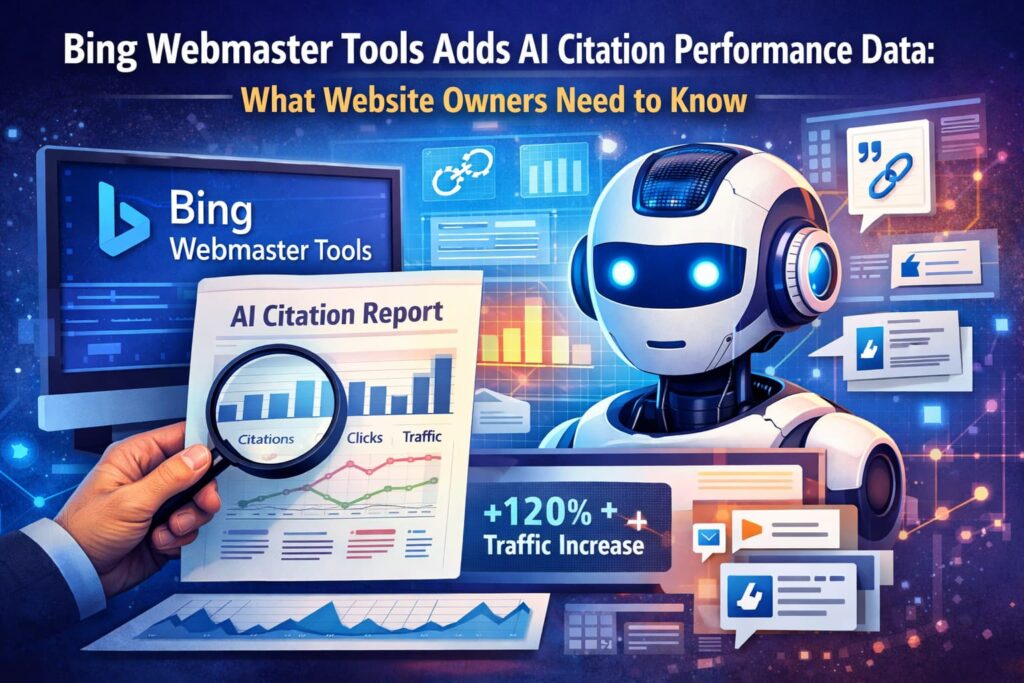
Bing Webmaster Tools just launched the first AI Performance dashboard, giving website owners unprecedented insight into how AI-generated search answers cite their content. The new analytics reveal citation counts, page-level performance data, and grounding queries—the exact phrases AI uses to retrieve your content. This changes everything about SEO strategy. Learn how to optimize your content for AI citations, track your visibility, and dominate the emerging landscape of AI-powered search engines.
If you’ve ever wondered whether AI search engines are actually citing your content, Bing just gave you the answer. The search giant rolled out a new AI Performance dashboard in Webmaster Tools that shows exactly how your pages perform in AI-generated responses—complete with citation counts, trending data, and the specific queries that trigger your content.
This is the first time any major search platform has pulled back the curtain on AI citations, and it matters more than you might think.
What Is Bing’s AI Performance Dashboard?
Bing’s AI Performance dashboard is a new analytics tool that tracks how often your website is cited in AI-generated search results. It provides three core metrics: the total number of citations your site receives, page-level performance showing which URLs are being referenced most often, and trend lines that reveal whether your AI visibility is growing or declining over time. This data provides unprecedented insight into how AI models select and surface your content when users ask questions.
The dashboard includes:
- Citation counts across your entire domain
- Page-level breakdowns showing your top-performing URLs
- Trend analysis reveals patterns over weeks and months
- Grounding queries—the actual search phrases AI used to retrieve your content
Why Grounding Queries Matter for Content Strategy
Grounding queries are the search phrases or questions that caused Bing’s AI to pull information from your pages when generating answers. These phrases show you the exact user intent your content is satisfying in AI responses, which differs significantly from traditional keyword rankings. Understanding grounding queries helps you identify content gaps, refine your topic coverage, and align your writing with the natural language questions people actually ask AI search engines.
Think of grounding queries as the bridge between what users ask and what AI answers. Here’s why they’re valuable:
- They reveal real user intent in conversational language, not just keywords
- They show topical gaps where you’re being cited—and where you’re not
- They help you optimize for question-based queries that dominate voice and AI search
- They provide competitive intelligence about which topics drive AI visibility
If you’re getting citations for “how to fix a leaky faucet” but not “best tools for plumbing repairs,” you’ve just identified your next content opportunity.
How This Changes SEO and Content Creation
Traditional SEO focused on ranking positions. AI search focuses on being the source of the answer. Bing’s new dashboard requires a fundamental shift: instead of optimising for page-one rankings, you need to optimize for citations in AI responses. This means your content must provide clear, authoritative, and extractable answers that AI models can confidently reference and attribute. The competition is no longer about outranking ten other websites—it’s about becoming the most trustworthy, relevant source AI selects when synthesising answers.
Here’s what shifts:
- Direct answers win: Your first paragraph needs to answer the core question in 45-55 words
- Structure beats style: Numbered lists, tables, and bullet points make content easier for AI to extract
- Authority is everything: Citations, data, and credible sources signal trustworthiness to AI models
- Conversational language matters: AI prioritises content written the way people actually talk and ask questions
How to Optimize Content for AI Citations
To maximise your AI citation potential, start every section with a complete, concise answer to the heading’s question in approximately 50 words. Use structured formats like numbered lists, comparison tables, and clearly labelled data points to make information easily extractable by AI models. Demonstrate expertise through original research, case studies, and credible source citations that establish your topical authority. Write in natural, conversational language that mirrors how users ask questions, and organise content hierarchically with clear H2 and H3 subheadings that address specific user intents.
Structural Best Practices
- Lead with the answer in your introduction and after every heading
- Use semantic HTML properly (H2, H3, lists, tables)
- Create scannable sections that AI can parse quickly
- Add data and statistics with clear attribution
- Include comparison tables when discussing alternatives or options
Content Quality Signals
- Demonstrate experience: Share first-hand observations, testing results, or unique data
- Cite credible sources: Reference studies, official documentation, or industry experts
- Update regularly: Fresh content signals relevance to both search engines and AI
- Answer follow-up questions: Anticipate what users might ask next and address it
- Use natural language: Write like you’re explaining to a colleague, not a machine
What Google AI Overviews Might Learn from This
While Google hasn’t released similar citation analytics for AI Overviews yet, Bing’s transparency sets a precedent that could pressure Google to follow. Website owners are increasingly asking how AI affects their traffic, and data visibility builds trust in the ecosystem. Google’s Search Console already tracks rich results and featured snippets—extending this to AI Overview citations would be a logical evolution that helps publishers adapt to generative search interfaces.
If Google implements something similar, expect:
- AI Overview citation tracking showing which pages appear in AI-generated answers
- Query analysis reveals what questions trigger your content
- Performance comparisons between traditional search and AI visibility
- Optimization recommendations specific to AI retrieval patterns
Immediate Action Steps for Website Owners
Access Bing Webmaster Tools today and navigate to the AI Performance dashboard to see your current citation data. Review your grounding queries to identify which topics are driving AI visibility and which content gaps exist. Audit your top-performing pages to understand what structural and content elements are earning citations, then apply those patterns to underperforming content. According to digital marketing analysts at Megrisoft UK, websites that restructure content to prioritise direct answers and extractable data formats typically see measurable improvements in AI citation rates within 60 to 90 days. Restructure key pages to lead with direct answers, incorporate more lists and tables, and ensure every heading is followed by a complete, concise response that AI can confidently extract and cite..
This week:
- Sign up for Bing Webmaster Tools if you haven’t already (it’s free)
- Check your AI Performance data and identify your top-cited pages
- Analyse grounding queries to spot content opportunities
- Audit one high-value page and restructure it for AI extraction
This month:
- Rewrite introductions to provide 45-55-word direct answers
- Convert paragraphs into lists where appropriate
- Add comparison tables for product reviews, how-to guides, or feature breakdowns
- Incorporate statistics and citations to boost E-E-A-T signals
- Monitor your trend lines to see if changes improve citation rates
Frequently Asked Questions (FAQs)
How do I access Bing’s AI Performance dashboard?
Access Bing’s AI Performance dashboard by logging into Bing Webmaster Tools at bing.com/webmasters and navigating to the AI Performance section in the left sidebar. You’ll need to verify your website ownership first using DNS, an HTML file upload, or a meta tag. The dashboard displays citation counts, grounding queries, and trend data once your site is verified and has accumulated AI citation activity.
What are grounding queries in Bing Webmaster Tools?
Grounding queries are the specific search phrases or questions that triggered Bing’s AI to retrieve and cite content from your website when generating answers. Unlike traditional keywords, grounding queries reveal the exact conversational language users employed when asking questions that your content answered. They show real user intent patterns and help identify which topics earn AI citations versus those that don’t.
Does Google offer a similar AI-based citation tracking service?
Google does not currently offer AI citation tracking or performance data for AI Overviews in Google Search Console. Bing is the first major search engine to provide transparency into how AI-generated answers cite website content. However, Google may introduce similar features in the future as website owners increasingly demand visibility into how generative AI affects their search traffic and content performance.
How long does it take to see AI citation improvements?
Most websites see measurable improvements in AI citation rates within 60 to 90 days after restructuring content for AI extractability. The timeline depends on how quickly search engines re-crawl your updated pages, the quality of your content improvements, and your existing domain authority. Focus on adding direct answers, structured data formats like lists and tables, and credible citations to accelerate results.
Can AI citations replace traditional SEO rankings?
AI citations complement traditional SEO rankings but don’t replace them entirely, as both serve different user behaviours and search contexts. Traditional rankings drive direct website traffic through search result clicks, while AI citations provide attributed answers within AI-generated responses. Websites need both strong rankings for discovery and click-through traffic, and citation-worthy content that AI models can reference confidently when synthesising answers for users.
What content formats get cited most by AI search?
Content with numbered lists, bullet points, comparison tables, and direct-answer paragraphs is cited most frequently by AI search engines. AI models prioritise easily extractable information that’s structured hierarchically with clear headings, concise definitions, and factual data supported by credible sources. Content demonstrating E-E-A-T principles—experience, expertise, authority, and trust—through original research, case studies, and proper citations earns significantly more AI visibility than unstructured paragraphs.
Do AI citations affect website traffic?
AI citations can both increase and decrease website traffic depending on implementation and user behaviour. When AI provides complete answers with attribution, some users click through to verify sources or learn more, which can increase traffic. However, if AI answers fully satisfy user intent without requiring additional context, click-through rates may decline. The key is creating content that invites deeper exploration beyond what AI summaries can provide.
The Future of Search Is Transparent
Bing’s AI Performance dashboard represents a significant shift toward transparency in how AI search works. For years, SEO has operated on educated guesses and correlation studies. Now, for the first time, you can see exactly when and how AI cites your content. This data doesn’t just help you optimize—it validates whether your content strategy is working in an AI-first search landscape.
The websites that adapt fastest to AI-driven search won’t just survive the transition—they’ll dominate it. Start tracking your citations today, optimize for extractability tomorrow, and build the topical authority that makes AI engines trust your content as the source of truth.
Because in AI search, being cited isn’t just about traffic. It’s about becoming the authority AI turns to when it needs an answer.
As AI-driven search reshapes content discovery, building citation-worthy authority requires strategic visibility across trusted editorial sources. If you’re ready to strengthen your presence in AI-generated answers, Megrisoft UK’s AI Citation Services can help—book a strategy call to discuss your outreach goals.


 UK
UK 
 US
US  CANADA