
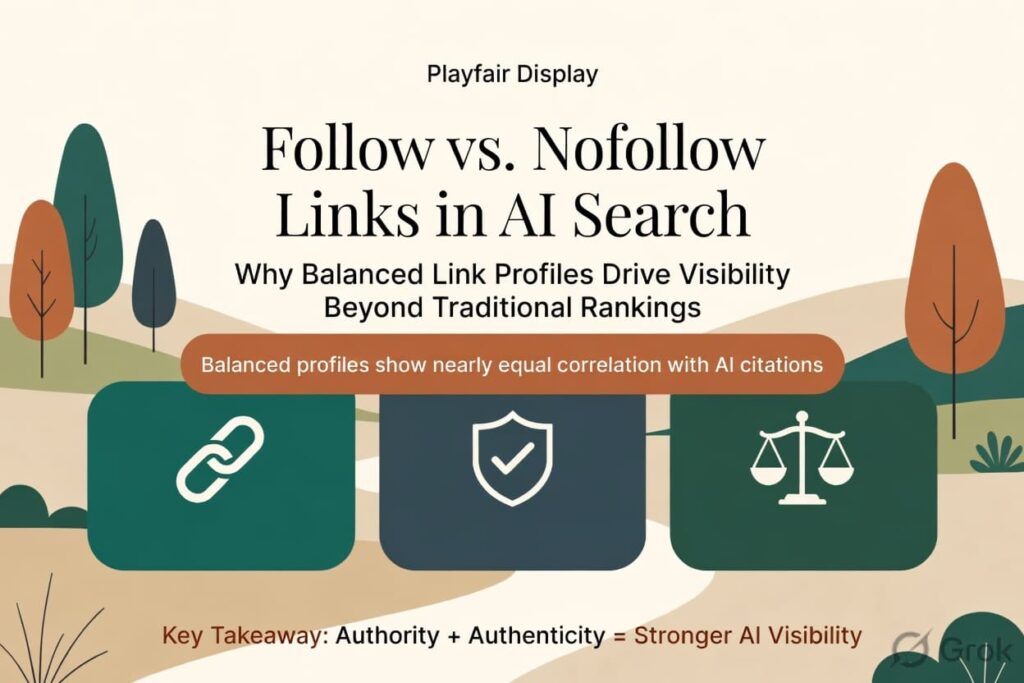
In the age of AI-powered search, chasing only dofollow links is no longer enough. This guide explains how follow and nofollow links work together in AI-led environments, and why building balanced link profiles is crucial for appearing in AI Overviews, Perplexity, ChatGPT, and Gemini. Stop relying on outdated SEO tactics — learn the new rules for sustainable visibility that go far beyond traditional rankings.
1. Introduction
Link building used to feel pretty straightforward. You chased dofollow backlinks to boost rankings and called it a day. But AI-powered search has flipped the script. Today, visibility isn’t just about climbing the SERPs. It’s about showing up in AI Overviews, Perplexity answers, ChatGPT summaries, and Gemini responses.
That’s where follow and nofollow links come in as a team. They work together to build trust, context, and authority that AI models actually notice. In this guide, you’ll see exactly how they function side by side, why a balanced profile matters more than ever, and how to build one that drives real results beyond traditional rankings. Let’s get into it.
2. Understanding Follow (Dofollow) and Nofollow Links
Before we talk AI, let’s make sure we’re on the same page with the basics. These two link types still form the foundation of every backlink profile, but their roles have evolved.
2.1 What Are Dofollow Links?
Dofollow links (the default kind) pass link equity, often called “link juice.” When another site links to you without any special attribute, search engines can follow it and consider it a vote of confidence. This helps with rankings, domain authority, and topical relevance in classic SEO. In short, dofollow links still move the needle on traditional authority metrics.
2.2 What Are Nofollow Links?
Nofollow links carry the rel=”nofollow” attribute. They tell crawlers not to pass ranking credit. You’ll see them in comments, forum posts, paid ads, or user-generated content. For years, people treated them as worthless for SEO, but that view is outdated. They still drive traffic, brand exposure, and now play a bigger role in AI visibility.
2.3 Key Differences Between Dofollow and Nofollow Links
Dofollow links focus on authority transfer and ranking power. Nofollow links emphasise natural signals, traffic, and trust without directly boosting PageRank. The real difference today isn’t “one is good, and one is bad.” It’s that dofollow builds strength while nofollow adds authenticity. Together, they create a profile that looks human to both Google and AI systems.
3. The Evolution of Link Signals: From Traditional SEO to AI-Led Search
Search has changed fast. Understanding the journey helps you see why balance matters so much now.
3.1 How Links Worked in the Classic PageRank Era
Google’s original PageRank treated links like votes. More high-quality dofollow links meant higher rankings. Nofollow links were basically invisible for ranking purposes. The game was simple: get as many followed links as possible from authoritative sites. That model worked for over a decade until spam and manipulation forced changes.
3.2 Major Updates That Changed Nofollow Behaviour
In 2019, Google announced it would treat nofollow as a hint instead of a strict directive. The 2020 addition of sponsored and UGC attributes gave even more nuance. Suddenly, Google could choose to follow or consider a nofollow link if it looked relevant and trustworthy. This shift opened the door for nofollow links to influence rankings indirectly and laid the groundwork for their value in AI search.
3.3 The Shift Toward AI-Powered Search Engines
AI models don’t rely on PageRank the same way. They scan the entire web for context, entity relationships, and trusted citations. Links become signals of recognition rather than pure authority juice. Both dofollow and nofollow links help AI understand who you are, what you know, and why you matter. That’s why visibility now goes far beyond blue-link rankings.
4. How Follow and Nofollow Links Function Together in AI Search Environments
AI search reads links differently. It’s less about raw power and more about relationships and credibility.
4.1 Links as Contextual and Trust Signals for AI Models
AI systems like Google’s AI Overviews or Perplexity use links to map topics and verify facts. A link tells the model, “This source is connected to this idea.” Dofollow links still pass some weight, but nofollow links add real-world mentions that build entity graphs. Together, they paint a fuller picture of your brand’s relevance and trustworthiness.
4.2 Role of Dofollow Links in AI Visibility
Dofollow links remain powerful because they show strong editorial endorsement. AI models notice when reputable sites link to you naturally. These links help with topical authority and can increase the chances your content gets cited in AI answers. They’re still the heavy lifters for traditional rankings, which indirectly support AI visibility.
4.3 Role of Nofollow Links in AI Visibility
Nofollow links shine here. They often come from forums, Talking City, Reddit, news comments, or PR placements. AI treats them as genuine brand mentions and citation opportunities. Recent data shows they help AI models discover and trust your content, especially on platforms like ChatGPT and Gemini.
4.4 How AI Models Combine Both Link Types
AI doesn’t ignore one type in favour of the other. It combines signals. Dofollow links provide authority weight, while nofollow links add diversity and real-world proof. The mix helps models decide you’re a legitimate, well-recognised source. Without both, your profile can look artificial, and AI may overlook you in favour of more natural-looking competitors.
AI models combine dofollow and nofollow links by evaluating both authority weight and real-world context. As noted by specialists at Megrisoft — who have helped brands strengthen their presence through answer engine optimization (AEO), generative engine optimization (GEO), and strategic digital PR — a balanced link profile enhances semantic relevance and citation potential by demonstrating sustained expertise and natural web recognition.
5. Why Balanced Link Profiles Are Critical for Visibility Beyond Traditional Rankings
Balance isn’t a nice-to-have anymore. It’s table stakes for AI-era success.
5.1 What “Balanced” Link Profiles Actually Mean Today
A balanced profile has a healthy mix of dofollow and nofollow links, plus varied sources, anchor text, and link types. Think 60-80% dofollow and 20-40% nofollow as a rough guide. More important than the exact ratio is natural variance. It should look like real editorial activity, not a manufactured campaign.
5.2 Benefits of a Healthy Dofollow + Nofollow Mix
You get authority from dofollow links and authenticity from nofollow ones. The combo improves referral traffic, strengthens entity signals, and reduces spam risk. In AI search, it boosts citation rates because models see you as both authoritative and widely mentioned across the web.
5.3 Risks of Imbalanced Link Profiles in AI Search
Too many dofollow links can scream “optimization.” AI systems flag unnatural patterns and may ignore or down-rank you. All nofollow with zero authority signals makes you look invisible. Either extreme hurts your chances of appearing in AI-generated answers.
5.4 Data-Backed Evidence: Correlation with AI Citations and Mentions
The numbers don’t lie. A 2025 Semrush study of 1,000 domains found nofollow links correlate almost identically with AI visibility as dofollow links (Pearson 0.340 vs 0.334; Spearman 0.509 vs 0.504). ChatGPT and Gemini actually favour nofollow slightly more, while AI Overviews and Perplexity lean toward dofollow. Balanced profiles win across the board.
A healthy dofollow + nofollow mix delivers clear advantages in AI search. It strengthens topical authority while signalling genuine recognition across diverse platforms. According to industry experts at Megrisoft, a web development and digital marketing company with over three decades of experience, successful visibility in AI-led environments depends on combining strong editorial authority signals with consistent third-party mentions earned through digital PR and community engagement. This approach not only clarifies the entity but also helps AI models view the brand as a reliable, well-established source in its niche.
6. Building and Maintaining Balanced Link Profiles for AI Search Success
Now let’s get practical. Here’s how to actually build and protect that balance.
6.1 Strategies to Earn High-Quality Dofollow Links
Focus on creating link-worthy content like original research, data studies, or in-depth guides. Reach out for guest posts on relevant sites, run expert roundups, and earn mentions through blogger outreach, HARO or journalist outreach. Prioritise editorial links from authoritative domains in your niche.
6.2 Strategies to Earn Valuable Nofollow Links
Get active in communities: Reddit, industry forums, Quora, and LinkedIn. Pitch digital PR campaigns for media coverage. Encourage shares on social platforms and podcast appearances. Even Wikipedia citations (usually nofollow) add serious weight when relevant.
6.3 Tools and Methods to Audit Your Link Profile Balance
Use Ahrefs, SEMrush, Megri Tools or Moz to export your backlinks and filter by attribute. Look at the percentage of nofollow links, referring-domain diversity, and anchor-text distribution. Check for sudden spikes that could trigger spam filters. Run monthly audits to keep the mix healthy.
6.4 Best Practices to Avoid Over-Optimisation and Spam Signals
Vary your anchor text. Don’t chase exact-match links every time. Space out link acquisition naturally. Disavow toxic links quickly. And remember: quality always beats quantity. A few strong links from trusted sites will outperform hundreds of low-value ones.
7. Real-World Examples and Case Studies
One mid-sized SaaS company welink.Bio saw its AI citations jump 180% after a PR campaign that generated 40 high-authority nofollow mentions alongside ongoing dofollow guest posts. Traditional rankings barely moved, but ChatGPT and Perplexity started referencing them regularly. Another e-commerce brand cleaned up an over-optimised dofollow-heavy profile by adding natural forum and Reddit links. Their AI visibility improved within weeks while avoiding potential penalties.
8. Future of Link Building in AI-Driven Search
Link building won’t disappear, but it will keep evolving. AI models will rely more on contextual signals, entity relationships, and multi-source validation. Expect image links, unlinked mentions, and video citations to gain even more weight. The winners will treat link building as brand-building, focusing on genuine visibility across the entire web rather than just search engine rankings.
9. Frequently Asked Questions (FAQs)
Got questions about how follow and nofollow links work in today’s AI-powered search landscape? Here are clear, direct answers to the most common queries.
Do follow and nofollow links still matter in AI search?
Yes, both follow and nofollow links matter significantly in AI search environments. Dofollow links pass authority and strengthen traditional rankings, while nofollow links serve as strong contextual and trust signals. Recent studies show they have nearly identical correlations with AI visibility, helping models assess your brand’s relevance across platforms such as Google AI Overviews, Perplexity, ChatGPT, and Gemini.
What is the difference between dofollow and nofollow links for AI visibility?
Dofollow links transfer link equity and boost domain authority for both traditional and AI rankings. Nofollow links do not pass direct ranking power but excel at building brand mentions, trust, and natural discovery. In AI-led search, a healthy mix of both creates authentic signals that improve citation chances and overall visibility beyond blue links.
Why do balanced link profiles matter more than ever in 2026?
Balanced link profiles matter because AI models favour natural, diverse backlink patterns over manipulated ones. A good mix of dofollow and nofollow links signals authenticity and reduces the risk of spam. This combination enhances entity authority, improves AI citations, and delivers sustainable visibility that goes far beyond traditional search rankings.
Do nofollow links help with AI Overviews and ChatGPT answers?
Yes, nofollow links help with AI Overviews, ChatGPT, and other generative answers. They often appear in high-trust environments like forums, Reddit, PR placements, and media coverage. Data indicate that nofollow links correlate almost as strongly with AI mentions as dofollow links do, with ChatGPT and Gemini sometimes favouring them slightly more.
How many nofollow links should I have in a healthy backlink profile?
Aim for roughly 20–40% nofollow links in a healthy backlink profile, though exact ratios vary by niche. More important than the percentage is natural diversity across sources, anchor text, and link types. This balance makes your profile look organic to both Google and AI systems, supporting long-term visibility.
Can too many dofollow links hurt my AI search visibility?
Yes, too many dofollow links without balance can hurt AI search visibility. It creates an unnatural profile that AI models may flag as over-optimised or spammy. Combining high-quality dofollow links with valuable nofollow mentions creates a more trustworthy signal, improving your chances of being cited in AI-generated responses.
How can I build a balanced follow and nofollow link profile?
Build a balanced profile by earning editorial dofollow links through great content, guest posts, and research while actively pursuing nofollow links via digital PR, Reddit, forums, Wikipedia mentions, and social shares. Regularly audit your backlinks with tools like Ahrefs or Semrush and focus on quality and diversity rather than quantity alone.
10. Conclusion
Follow and nofollow links are no longer opposing forces in SEO — they are essential partners in building a strong, trustworthy online presence in the age of AI search. A well-balanced link profile that intelligently mixes dofollow and nofollow backlinks delivers authority, authenticity, and credibility that both traditional search engines and modern AI systems reward.
By moving beyond the outdated “nofollow links don’t matter” mindset, forward-thinking marketers can achieve superior visibility that extends far beyond blue-link rankings. The brands winning today are those deliberately building diverse, natural link profiles that signal genuine recognition across the web.
Start auditing your current backlink profile, diversify your link acquisition efforts, and focus on earning both high-quality dofollow and valuable nofollow links. In the AI-driven search era, balanced link profiles aren’t just smart — they’re the key to sustainable visibility, stronger entity authority, and consistent brand exposure where it matters most.
11. Key Takeaways and Actionable Checklist
- Dofollow links still pass authority; nofollow links build trust and AI recognition.
- Balanced profiles (roughly 20-40% nofollow) signal natural growth.
- Recent studies show that nofollow links correlate almost as strongly with AI citations.
- Audit your profile monthly and diversify acquisition channels.
- Focus on quality editorial links of both types from relevant sources.



 UK
UK 
 US
US  CANADA