
AI SEO services are becoming an essential part of modern digital marketing as search evolves beyond traditional search engines.
Businesses now need to optimise their online presence not only for Google Search but also for AI-powered platforms such as ChatGPT, Google AI Overviews, Gemini, Perplexity and Microsoft Copilot. While many companies understand the importance of AI visibility, choosing the right AI SEO services can be challenging. This guide explains the core services available, how they work together, and which solutions your business actually needs to improve visibility, authority and long-term growth across both search engines and AI-driven search experiences.
Increasingly, users are turning to artificial intelligence platforms such as ChatGPT, Google AI Overviews, Gemini, Claude and Perplexity to ask questions, compare products and research companies. Instead of scrolling through pages of search results, they now expect direct, conversational answers that summarise information from multiple trusted sources.
This shift is redefining what it means to be visible online.
This changing landscape has given rise to a new generation of services collectively referred to as AI SEO.
AI SEO combines established search engine optimisation principles with emerging disciplines such as AI Search Optimisation, Generative Engine Optimisation (GEO), Answer Engine Optimisation (AEO), Entity SEO, AI Brand Mentions and AI Visibility. Together, these services help businesses strengthen their digital authority, improve how artificial intelligence understands their brand and increase the likelihood of appearing within AI-generated recommendations.
The challenge for many organisations is understanding where to begin. With so many new terms entering the industry, it can be difficult to distinguish between genuinely valuable services and marketing buzzwords. Some businesses may benefit most from improving their technical SEO, whilst others may require stronger editorial authority, structured data or Digital PR to enhance their visibility across AI-powered search platforms.
This guide has been created to simplify that decision-making process.
Rather than promoting a single service, we explain the complete AI SEO ecosystem, how each service works, who it is designed for and how different strategies complement one another. Whether you are an established enterprise, an ambitious SME or a growing start-up, this guide will help you understand which AI SEO services are most relevant to your business and how they can contribute to sustainable online growth.
What Are AI SEO Services?
Artificial intelligence is changing how search engines interpret information and how people search for it. Whilst the term “AI SEO” is becoming increasingly common, it does not describe a single service. Instead, it represents a collection of complementary strategies designed to improve how businesses are discovered across both traditional search engines and AI-powered search platforms.
At its core, AI SEO builds upon the foundations of conventional SEO rather than replacing them. Technical optimisation, high-quality content and website performance remain essential. However, AI systems evaluate organisations using a much broader range of signals, including editorial authority, entity recognition, structured information, brand reputation and topical expertise.
As a result, modern search optimisation now extends beyond improving rankings for individual keywords. Businesses must also ensure their content is understandable to AI systems, their brand is consistently referenced across trusted sources, and their digital presence demonstrates genuine expertise within their industry. AI SEO services have therefore evolved to address these broader objectives.
Some services focus on strengthening a website’s technical foundation through structured data, internal linking and performance improvements. Others concentrate on increasing authority through Digital PR, editorial brand mentions and thought leadership. More specialised services, such as Generative Engine Optimisation (GEO) and Answer Engine Optimisation (AEO), help businesses create content that is more likely to be understood and referenced within AI-generated responses.
Rather than viewing these services as isolated activities, they should be considered as interconnected components of a long-term visibility strategy. The strongest AI SEO campaigns combine technical excellence, authoritative content, trusted editorial coverage and ongoing optimisation to ensure businesses remain discoverable regardless of how search technology continues to evolve.
Why Businesses Need AI SEO Services
Many organisations still associate SEO with improving rankings for a handful of keywords. Whilst search rankings remain valuable, they represent only one part of today’s digital landscape.
Consumers are increasingly asking AI platforms for recommendations instead of conducting multiple searches themselves. A prospective customer might ask ChatGPT to recommend the best accounting software for small businesses, request Gemini to compare cybersecurity providers or use Google AI Overviews to summarise different digital marketing agencies before visiting a single website.
These interactions reduce the number of websites users actively browse. Instead, AI systems decide which organisations deserve to be included within their responses.
To earn that visibility, businesses need more than technically optimised websites. They need a digital presence that demonstrates authority, expertise and credibility across numerous trusted sources.
This is precisely where AI SEO services provide value.
By combining technical optimisation, structured data, authoritative content, Digital PR and editorial visibility, businesses can strengthen the signals that AI systems rely upon when interpreting and recommending organisations. Another important consideration is consistency.
AI models compare information across websites, business profiles, publications, directories and other trusted resources. Inconsistent company information, weak content or a lack of independent references can reduce confidence in a brand’s authority. AI SEO services help organisations create a stronger, more consistent digital footprint that supports both conventional search rankings and AI-powered discovery. Rather than preparing businesses for a future that may arrive, AI SEO addresses a transformation that is already underway. Organisations investing today are positioning themselves to remain visible as search continues to evolve, whilst those relying solely on traditional optimisation risk becoming less prominent within the AI-driven search experiences that are increasingly influencing purchasing decisions.
The Megrisoft AI Visibility Framework
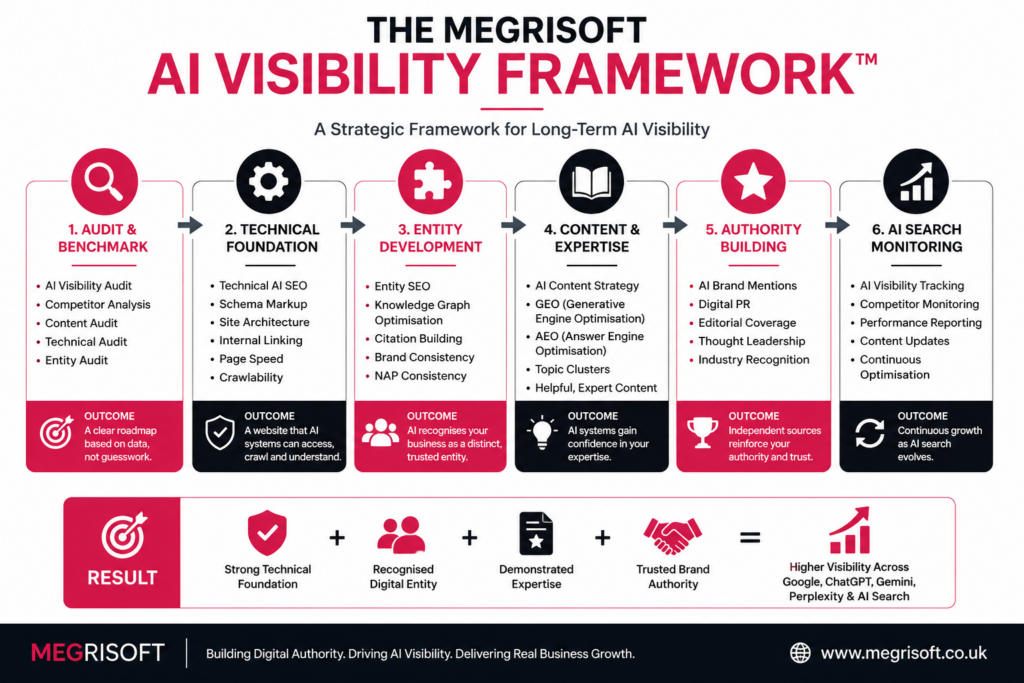
AI SEO is most effective when approached as a structured process rather than a collection of individual services. At Megrisoft, we believe businesses achieve the strongest long-term results by building AI visibility in progressive stages. Each stage strengthens the next, creating a digital presence that is easier for both search engines and AI platforms to understand, trust and recommend.
We call this The Megrisoft AI Visibility Framework
Stage 1 – Audit & Benchmark
Objective
Understand where your business stands today. Before investing in optimisation, you need to understand how AI platforms currently perceive your brand.
Activities include:
AI Visibility Audit
Competitor Analysis
Technical SEO Audit
Content Audit
Entity Audit
Outcome
A clear roadmap based on data rather than assumptions.
Stage 2 – Build the Technical Foundation
AI cannot recommend what it struggles to understand. This stage focuses on making your website technically excellent.
Activities include:
Technical AI SEO
Structured Data
Website Architecture
Internal Linking
Page Speed
Crawlability
Outcome
A website that’s accessible to both Google and AI systems.
Stage 3 – Develop Your Digital Entity
Once the website is technically strong, the next objective is helping AI understand who your business actually is.
Activities include:
Entity SEO
Knowledge Graph Optimisation
Citation Building
Consistent Business Information
Outcome
AI recognises your business as an authoritative organisation rather than simply another website.
Stage 4 – Demonstrate Expertise
This stage focuses on proving that your business deserves to be recommended.
Activities include:
AI Content Strategy
GEO
AEO
Topic Clusters
Industry Guides
Expert Resources
Outcome
AI systems gain confidence in your expertise.
Stage 5 – Build Authority Beyond Your Website
One of the biggest differences between traditional SEO and AI SEO is that authority increasingly comes from outside your own website.
Activities include:
AI Brand Mentions
Digital PR
Editorial Outreach
Thought Leadership
Media Coverage
Outcome
Independent websites reinforce your expertise.
Stage 6 – Measure & Improve
AI SEO is not a one-time project.
Businesses should continuously monitor how their visibility evolves.
Activities include:
AI Search Monitoring
Competitor Tracking
Content Updates
Authority Growth
Performance Reviews
Outcome
Continuous improvement as AI search evolves.
The Megrisoft AI Visibility Framework provides a structured roadmap for businesses looking to improve their presence across both traditional search engines and AI-powered search platforms. Rather than treating AI SEO as a collection of disconnected services, the framework combines technical excellence, entity development, authoritative content, digital authority, and ongoing optimisation into one strategic process that supports sustainable long-term growth.
The Complete AI SEO Services Comparison
The rapid evolution of AI-powered search has introduced a wide range of new optimisation services, each addressing a different aspect of digital visibility. Whilst many of these services overlap, they should not be viewed as competing solutions. Instead, they form part of a broader AI Search Optimisation strategy, with each service contributing towards a stronger, more authoritative online presence.
Some businesses require a stronger technical foundation before investing in Digital PR or AI Brand Mentions. Others may already have excellent websites but lack the editorial authority needed to improve their visibility across AI-powered search platforms. Understanding the purpose of each service allows organisations to invest more strategically and build an AI SEO roadmap that reflects their objectives, budget and stage of growth.
The comparison below provides a high-level overview of the most widely adopted AI SEO services and the role each one plays within a modern search strategy.
| AI SEO Service | Primary Objective | Best Suited For | Business Impact | Works Best Alongside |
|---|---|---|---|---|
| AI Search Optimisation | Improve visibility across AI-powered search platforms | All businesses | ★★★★★ | Technical SEO, Entity SEO, Digital PR |
| AI Visibility Audit | Measure current AI search performance | Businesses beginning their AI journey | ★★★★☆ | AI Search Optimisation |
| AI Brand Mentions | Increase authority through editorial references | Competitive industries | ★★★★★ | Digital PR, Entity SEO |
| AI Citation Building | Improve trusted references across the web | Growing brands | ★★★★☆ | AI Brand Mentions |
| Generative Engine Optimisation (GEO) | Optimise for AI-generated search responses | Content-led businesses | ★★★★★ | AEO, Technical SEO |
| Answer Engine Optimisation (AEO) | Improve conversational answers | Service businesses | ★★★★☆ | GEO, Content Strategy |
| Entity SEO | Strengthen brand recognition | Established businesses | ★★★★★ | Knowledge Graph Optimisation |
| Knowledge Graph Optimisation | Improve business identity across search | Medium to large organisations | ★★★★☆ | Entity SEO |
| AI Content Strategy | Build topical authority | Businesses investing in content | ★★★★★ | GEO, Technical SEO |
| Technical AI SEO | Create an AI-friendly website | Every website | ★★★★★ | All AI SEO services |
| AI Digital PR | Build authority through trusted media | National and international brands | ★★★★★ | AI Brand Mentions |
| AI Search Monitoring | Measure AI visibility over time | Businesses with ongoing campaigns | ★★★★☆ | AI Search Optimisation |
Rather than selecting a single service, most organisations achieve the strongest results by combining several of these disciplines into one coordinated strategy. The sections below explain how each service works, when it becomes valuable and how it contributes to long-term AI visibility.
AI Search Optimisation
AI Search Optimisation sits at the centre of every modern AI SEO strategy. Rather than focusing solely on achieving higher rankings within traditional search engines, it aims to improve how businesses are understood, evaluated and recommended by AI-powered search platforms. The objective is simple: when someone asks ChatGPT, Google AI, Gemini or another AI assistant a question related to your industry, your business should have the strongest possible chance of being recognised as a credible and authoritative source.
Achieving this requires considerably more than publishing optimised web pages. AI Search Optimisation combines technical SEO, structured data, entity development, Digital PR, editorial authority and content strategy into a unified framework that strengthens a brand’s overall digital presence. Unlike traditional SEO, which often concentrates on individual keywords, AI Search Optimisation focuses on broader topics and relationships. AI systems attempt to understand organisations in context, evaluating whether a business consistently demonstrates expertise across multiple trusted sources rather than simply analysing one website.
Example: AI Search Optimisation in Practice
Imagine a regional accountancy firm that wants to appear when someone asks ChatGPT, “Who are the best accountants for small businesses in London?”
Ranking for keywords such as accountants London is only one part of the challenge. To improve AI visibility, the firm would also need a technically optimised website, well-structured service pages, informative guides covering tax and bookkeeping topics, consistent business information across trusted platforms, and editorial mentions from respected financial publications.
By combining these signals, the business builds stronger authority that both search engines and AI platforms can understand and trust.
AI Visibility Audits
Before investing in any optimisation strategy, businesses should understand how they currently appear across AI-powered search platforms. An AI Visibility Audit provides that benchmark. Unlike a conventional SEO audit, which focuses primarily on technical issues and keyword performance, an AI Visibility Audit examines how artificial intelligence systems interpret your business, where your brand is mentioned, how consistently information is presented and whether sufficient authority signals exist to support AI-generated recommendations.
The audit normally reviews website quality, structured data, entity consistency, editorial mentions, Digital PR activity, branded search visibility, topical authority and competitor positioning. It also identifies opportunities to strengthen AI readiness by highlighting missing authority signals and content gaps. One of the greatest advantages of this service is that it allows businesses to prioritise investment. Rather than implementing multiple AI SEO services simultaneously, organisations gain a clear understanding of which areas require attention first.
Imagine two software companies offering almost identical services. Both have technically sound websites, but one is regularly referenced in industry publications, appears on comparison websites and has consistent business information across trusted sources. The other relies almost entirely on its own website. An AI Visibility Audit would quickly identify these differences and highlight why one business is more likely to be recognised by AI-powered search platforms.
AI Brand Mention Services
AI systems place significant emphasis on trust, credibility and authority. Whilst backlinks remain valuable, they are only one indicator of digital reputation. Editorial references, expert commentary and consistent mentions across respected publications increasingly contribute to how AI interprets a brand. AI Brand Mention Services focus on strengthening these authority signals.
Rather than pursuing links for their own sake, this service aims to increase the quality and relevance of independent references to your business across trusted online publications, industry websites, magazines, news outlets and authoritative blogs. Editorial mentions help reinforce expertise because they demonstrate that third parties recognise your business as a credible source of information. They also contribute towards stronger entity recognition, improved topical authority and greater confidence in your brand across AI-powered search platforms.
One of the most common mistakes businesses make is focusing exclusively on backlinks. Whilst backlinks remain valuable, we’ve observed that editorial mentions in respected publications often provide stronger trust signals because they demonstrate that independent sources recognise the business as an authority rather than simply linking to it.
AI Citation Building
Whilst AI Brand Mentions focus on increasing editorial visibility, AI Citation Building concentrates on strengthening the quality and consistency of references that support a business’s credibility across the wider web.AI systems frequently compare information from multiple sources before generating responses. Organisations with accurate, consistent and authoritative references are generally easier for AI platforms to understand and trust.
Citation Building therefore involves identifying opportunities to increase high-quality references across industry resources, research publications, professional directories, expert articles and reputable third-party websites. Unlike traditional citation management associated with Local SEO, AI Citation Building adopts a broader approach by considering how trusted sources collectively reinforce a brand’s authority. For businesses seeking long-term AI visibility, citation development complements Digital PR and editorial outreach by ensuring that authoritative information is consistently available wherever AI systems gather evidence.
Generative Engine Optimisation (GEO)
Generative Engine Optimisation (GEO) is one of the fastest-growing disciplines within AI SEO. Whilst traditional SEO focuses on helping web pages rank in search engine results, GEO is designed to improve how content is interpreted and referenced by generative AI platforms.
Modern AI search engines do not simply display a list of websites. They analyse information from multiple trusted sources before producing conversational answers that summarise the most relevant and authoritative content. GEO helps businesses structure their websites and content so that this information is easier for AI systems to understand, evaluate and reference.
Successful GEO campaigns begin by understanding how people naturally ask questions. Instead of targeting short keywords, content is created around complete topics, real-world problems and conversational search intent. Information is organised logically, supported with evidence and presented in a format that AI systems can interpret with confidence. Another important aspect of GEO is content depth. AI platforms tend to favour comprehensive resources that demonstrate genuine expertise rather than thin articles written solely to target keywords. Well-structured guides, comparison pages, research reports and educational content often perform better because they provide complete answers rather than isolated pieces of information.
Rather than publishing a short article targeting “AI SEO Services”, GEO encourages businesses to create comprehensive resources that explain the topic from multiple perspectives. This guide is an example of GEO in practice because it covers definitions, comparisons, use cases, FAQs and strategic recommendations within a single resource.
Best suited for: Businesses publishing regular content, SaaS companies, B2B organisations, eCommerce brands and businesses seeking long-term authority.
Answer Engine Optimisation (AEO)
Consumers increasingly ask complete questions rather than typing a handful of keywords into a search engine. Whether using Google AI Overviews, ChatGPT or voice assistants, people expect direct, accurate and well-structured answers.
Answer Engine Optimisation (AEO) focuses on helping businesses create content that satisfies these conversational search experiences.
Unlike traditional SEO, which often targets broad keyword themes, AEO concentrates on providing clear responses to specific questions that potential customers are likely to ask throughout their buying journey. The objective is to become the most useful answer rather than simply the highest-ranking webpage.
Effective AEO begins with understanding user intent. Businesses identify the questions customers regularly ask, organise information logically and provide concise explanations supported by more detailed guidance where appropriate. Content is structured using descriptive headings, clear language and logical progression so that both users and AI systems can interpret the information easily.
AEO also supports featured snippets, People Also Ask results and AI-generated summaries by presenting information in a format that is straightforward to reference. For service-based businesses, professional firms and organisations operating within complex industries, Answer Engine Optimisation provides an opportunity to demonstrate expertise whilst improving visibility across an increasing number of AI-powered search experiences.
Instead of targeting a keyword such as “AI SEO”, Answer Engine Optimisation encourages businesses to answer questions like:
What is AI SEO?
Is AI SEO replacing traditional SEO?
Which AI SEO services should small businesses invest in?
This mirrors how people increasingly interact with AI assistants.
Entity SEO
Search engines and AI systems are becoming increasingly sophisticated in the way they understand organisations. Rather than analysing websites in isolation, they attempt to identify businesses as entities with defined relationships, expertise and areas of authority.
Entity SEO focuses on strengthening this digital identity.
Instead of relying purely on keywords, Entity SEO helps search engines understand who your business is, what services you provide, which industries you specialise in and how your organisation relates to other recognised entities across the web. This process relies upon consistency. Business names, services, locations, leadership information, structured data and editorial references should all communicate the same clear message. The stronger these signals become, the easier it is for AI platforms to recognise your organisation as a trusted source.
Entity SEO also plays an important role in improving topical authority. By consistently publishing expert content around clearly defined subject areas, businesses reinforce the relationship between their brand and the topics they wish to be recognised for. As AI continues to prioritise expertise and trust, Entity SEO is becoming one of the most valuable long-term investments within any AI Search Optimisation strategy.
Best suited for: Established brands, growing businesses, professional services and organisations investing in long-term digital authority.
Knowledge Graph Optimisation
Knowledge Graph Optimisation complements Entity SEO by helping search engines connect the various pieces of information that define a business.
Rather than viewing a website in isolation, search engines analyse multiple trusted sources to verify facts about an organisation, including its services, leadership, industry, locations and relationships with other recognised entities.
Knowledge Graph Optimisation focuses on improving the consistency and accuracy of these signals. This may involve implementing structured data, maintaining accurate business information, strengthening authoritative citations and ensuring that company profiles across trusted platforms remain aligned. The objective is to reduce ambiguity and provide search engines with greater confidence when interpreting your organisation. Although businesses cannot directly control how knowledge graphs are generated, they can significantly improve the quality and consistency of the information available to search engines and AI platforms.
For organisations seeking stronger brand recognition across search, Knowledge Graph Optimisation provides an important foundation that supports both traditional SEO and AI Search Optimisation.
Best suited for: Medium to large organisations, established brands, multi-location businesses and companies investing in long-term brand authority.
AI Content Strategy
Content remains one of the strongest signals of expertise, but modern content strategies require considerably more than publishing blog posts around popular keywords.
AI Content Strategy focuses on developing comprehensive content ecosystems that demonstrate genuine authority across an entire subject area.
Rather than producing isolated articles, businesses create interconnected resources covering every stage of the customer journey. Educational guides, comparison articles, service pages, industry research, frequently asked questions and thought leadership all contribute towards building topical authority. A successful AI Content Strategy begins by understanding audience needs rather than search volumes alone. Content should answer real questions, solve genuine problems and provide insights that cannot easily be found elsewhere. AI systems increasingly favour information that demonstrates depth, originality and expertise.
Topic clusters also play an important role. Related articles should support one another through logical internal linking, allowing search engines and AI platforms to understand the relationships between different subjects and identify areas of specialisation. When combined with Technical AI SEO, Entity SEO and Digital PR, a strong content strategy becomes one of the most valuable long-term assets within any AI Search Optimisation campaign.
We’ve found that publishing ten related articles around one specialist topic usually produces stronger long-term authority than publishing fifty unrelated blog posts. Topic depth consistently outperforms content volume when building expertise for AI-powered search.
AI Content Optimisation
Many organisations already possess valuable content but fail to realise its full potential because it has not evolved alongside modern search behaviour.
AI Content Optimisation focuses on improving existing pages to ensure they remain relevant across both traditional search engines and AI-powered search experiences.
The process begins with a detailed content audit to identify outdated information, gaps in topic coverage, weak internal linking, inconsistent messaging and opportunities to improve clarity. Existing articles are then enhanced through improved structure, readability, and semantic relevance, and the inclusion of expert insights or supporting evidence where appropriate. ,Unlike simple keyword optimisation, AI Content Optimisation aims to make content more useful and authoritative. Pages are refined to answer questions more effectively, provide clearer explanations and demonstrate genuine expertise, making them more valuable to both readers and AI systems. For businesses with extensive content libraries, optimisation often delivers faster and more cost-effective improvements than continually publishing new articles.
Best suited for: Businesses with existing blogs, knowledge bases, resource centres and large website archives.
Technical AI SEO
Every successful AI SEO strategy is built upon strong technical foundations. Without a technically sound website, even the most authoritative content may struggle to achieve its full potential.
Technical AI SEO focuses on ensuring that websites are accessible, well organised and easy for both search engines and AI systems to interpret. This includes improving website architecture, crawlability, page speed, mobile usability, structured data implementation, internal linking and overall site performance.
A technically optimised website enables AI platforms to understand relationships between pages, interpret structured information more accurately and access content efficiently. It also improves user experience, which remains a fundamental component of long-term search performance. Technical AI SEO should not be viewed as a one-off exercise. Regular audits, monitoring, and ongoing maintenance help ensure websites continue to perform effectively as search technology evolves. For every business investing in AI Search Optimisation, technical excellence provides the essential platform upon which all other optimisation activities depend.
Best suited for: Every business, regardless of industry or website size.
AI Digital PR
As AI systems increasingly evaluate trust and authority, Digital PR has become one of the most influential components of AI SEO.
Unlike traditional public relations, AI Digital PR focuses on earning meaningful editorial coverage that strengthens both brand reputation and online visibility. High-quality mentions within respected publications, industry magazines and trusted websites help establish credibility that extends well beyond backlinks alone.
Successful campaigns often combine original research, expert commentary, data-driven stories and thought leadership to generate coverage that is genuinely valuable to journalists and readers. These editorial references reinforce expertise whilst contributing towards stronger entity recognition and broader digital authority.
AI Digital PR also complements almost every other AI SEO service. Technical SEO ensures that websites perform efficiently, content strategy provides valuable resources worth referencing and Digital PR amplifies that expertise by placing it in front of wider audiences. As AI-powered search continues to favour organisations with established authority, businesses investing in Digital PR are increasingly well positioned to strengthen both traditional search performance and AI visibility.
Best suited for: Competitive industries, national brands, B2B organisations, technology companies and businesses seeking long-term authority.
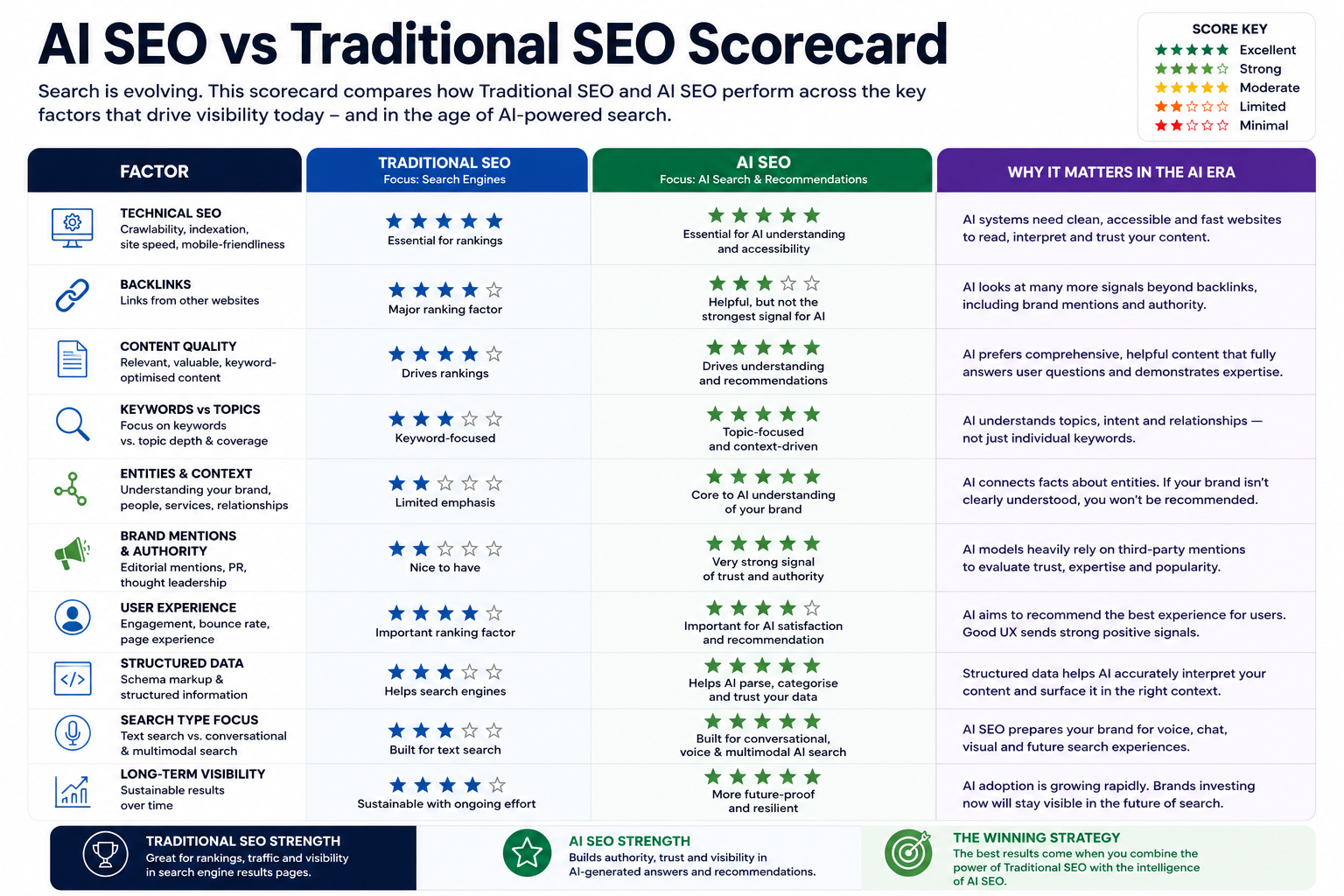
Why These Services Work Better Together
One of the most common misconceptions surrounding AI SEO is that businesses need to choose a single optimisation service. In reality, the greatest improvements in AI visibility occur when multiple disciplines work together.
For example, Technical AI SEO ensures that a website is accessible and easy for AI systems to interpret. AI Content Strategy provides comprehensive, authoritative information that answers user questions. AI Brand Mentions and Digital PR strengthen credibility through independent editorial coverage, whilst Entity SEO and Knowledge Graph Optimisation help search engines and AI platforms understand exactly who the business is and what it represents.
Each service reinforces the others. A technically excellent website without authority may struggle to earn recommendations, whilst strong editorial coverage cannot fully compensate for poor website structure or weak content. By combining complementary services into a unified strategy, businesses create a stronger foundation for long-term visibility across both traditional search engines and AI-powered discovery platforms.
At Megrisoft, we’ve found that businesses often invest in technical SEO first, but AI visibility tends to improve most noticeably after building consistent editorial mentions across authoritative publications. In many campaigns, technical improvements alone aren’t enough to increase AI recommendations.
Common AI SEO Mistakes We See Businesses Make
After working with organisations across a wide range of industries, we’ve noticed several recurring mistakes that limit AI visibility.
- Treating AI SEO as a replacement for traditional SEO rather than an extension of it.
- Publishing AI-generated content without adding original expertise or practical insights.
- Focusing on backlinks while overlooking editorial mentions and entity development.
- Building isolated blog posts instead of comprehensive topic clusters.
- Ignoring structured data and technical foundations.
- Expecting AI visibility to improve overnight rather than viewing it as a long-term strategy.
Which AI SEO Services Does Your Business Actually Need?
One of the biggest misconceptions surrounding AI SEO is that every business requires the same combination of services. In reality, the most effective strategy depends on your industry, business size, digital maturity and commercial objectives.
A newly launched start-up has very different requirements from an established enterprise with thousands of indexed pages. Likewise, an eCommerce retailer selling hundreds of products will prioritise different optimisation activities from a legal practice or accountancy firm looking to establish trust and authority.
The key is to invest in the services that will deliver the greatest impact for your business today whilst creating a roadmap for future growth. Rather than attempting to implement every AI SEO service at once, organisations should build their strategy in stages, beginning with strong technical foundations before expanding into authority-building, content development, and AI visibility.
The recommendations below provide a practical starting point for different types of businesses.
AI SEO for Start-ups
For new businesses, visibility can be one of the greatest challenges. Without an established reputation, search engines and AI platforms have limited information available to evaluate your expertise or credibility. The priority should therefore be building a solid digital foundation rather than chasing rapid rankings.
Start-ups should begin with Technical AI SEO to ensure their website is accessible, fast and structured correctly. This should be supported by an AI Visibility Audit to identify any weaknesses in the site’s readiness for AI-powered search. Once these foundations are in place, investment should shift towards AI Content Strategy, enabling the business to develop authoritative resources around its specialist areas.
As the company grows, AI Brand Mentions and Digital PR become increasingly valuable because they help establish independent recognition across trusted publications and industry websites.
Technical AI SEO
AI Visibility Audit
AI Content Strategy
Entity SEO
AI Brand Mentions
AI SEO for Small and Medium-Sized Businesses
Many SMEs already have an established customer base and a functioning website but struggle to compete with larger organisations that have greater marketing budgets. AI SEO offers an opportunity to compete through expertise and authority rather than scale alone.
For SMEs, the focus should be on strengthening technical performance, improving content quality and increasing editorial visibility. AI Search Optimisation provides the overall strategy, whilst Entity SEO helps reinforce the business’s expertise within its chosen sector.
Digital PR and AI Brand Mentions become particularly valuable because they generate independent authority that AI systems increasingly rely upon when evaluating businesses.
AI Search Optimisation
Technical AI SEO
Entity SEO
AI Brand Mentions
AI Digital PR
AI Search Monitoring
AI SEO for eCommerce Businesses
Online retailers operate within highly competitive search environments where customers often compare multiple products before making purchasing decisions. AI-powered shopping experiences are making product discovery increasingly conversational, meaning visibility depends upon much more than optimised product descriptions.
eCommerce businesses should prioritise Technical AI SEO to ensure products can be crawled efficiently and structured data is implemented correctly. Product pages should be supported by buying guides, comparison articles and educational content that demonstrates expertise rather than focusing solely on transactions.
Entity SEO, AI Content Strategy and AI Brand Mentions help strengthen trust signals, whilst Digital PR generates authoritative references that improve brand recognition across the wider web.
Technical AI SEO
Schema Optimisation
AI Content Strategy
AI Brand Mentions
AI Digital PR
AI Search Optimisation
AI SEO for SaaS Companies
Software businesses face a unique challenge. Prospective customers often spend considerable time researching alternatives, comparing features and reading independent reviews before making purchasing decisions.
Successful SaaS SEO therefore extends beyond ranking for product keywords. Businesses should create detailed comparison pages, implementation guides, use cases and thought leadership that establish expertise throughout the buying journey.
Entity SEO becomes particularly important because AI systems increasingly evaluate software providers as recognised organisations rather than simply collections of web pages. Digital PR, founder thought leadership and editorial coverage further strengthen authority within competitive technology markets.
AI Search Optimisation
AI Content Strategy
Entity SEO
AI Brand Mentions
AI Digital PR
Knowledge Graph Optimisation
AI SEO for Professional Services
Professional service firms such as solicitors, accountants, consultants and financial advisers rely heavily on trust. Potential clients often ask AI platforms for recommendations before contacting a provider, making credibility one of the most important factors influencing visibility.
Professional services should invest in authoritative content that answers common client questions whilst demonstrating specialist expertise. Entity SEO, Knowledge Graph Optimisation and AI Brand Mentions help reinforce professional credibility, whilst Digital PR positions the firm’s experts as recognised voices within their industry.
Technical SEO remains essential, but long-term authority is built through consistent expertise rather than technical optimisation alone.
AI Search Optimisation
Entity SEO
AI Brand Mentions
Knowledge Graph Optimisation
AI Content Strategy
AI Digital PR
AI SEO for Healthcare Organisations
Healthcare providers operate within one of the most trust-sensitive industries online. Patients expect accurate, evidence-based information, and search engines place particular emphasis on content quality, expertise and credibility.
Healthcare organisations should prioritise authoritative content written or reviewed by qualified professionals, supported by structured data and strong technical SEO. Editorial references from recognised healthcare publications and institutions further strengthen authority.
Consistency, accuracy and transparency are essential because both users and AI systems expect reliable medical information.
Technical AI SEO
AI Content Strategy
Entity SEO
Knowledge Graph Optimisation
AI Brand Mentions
AI Search Monitoring
AI SEO for Travel and Hospitality Businesses
Travel decisions increasingly begin with conversational searches. Users ask AI assistants to recommend destinations, compare hotels or suggest itineraries, expecting detailed and personalised recommendations.
Businesses within this sector should focus on creating destination guides, local expertise and experience-led content rather than relying solely on accommodation or service pages. Editorial mentions from respected travel publications, bloggers and lifestyle magazines can significantly strengthen authority.
Technical SEO and structured data remain important, particularly for helping search engines understand locations, reviews and travel-related information.
AI Search Optimisation
AI Content Strategy
AI Brand Mentions
AI Digital PR
Technical AI SEO
Entity SEO
Building Your AI SEO Roadmap
The most successful businesses do not treat AI SEO as a collection of isolated services. Instead, they develop a structured roadmap that evolves alongside their growth.
For most organisations, the journey begins with understanding their current position through an AI Visibility Audit, followed by strengthening technical foundations and content quality. Once these elements are established, authority-building activities such as AI Brand Mentions, Digital PR and Entity SEO become increasingly valuable.
Finally, ongoing monitoring and optimisation ensure that visibility continues to improve as AI-powered search platforms evolve.
Rather than asking, “Which single AI SEO service do we need?”, businesses should ask, “Which combination of services will best support our long-term growth?” That shift in thinking transforms AI SEO from a collection of tactics into a sustainable digital strategy.
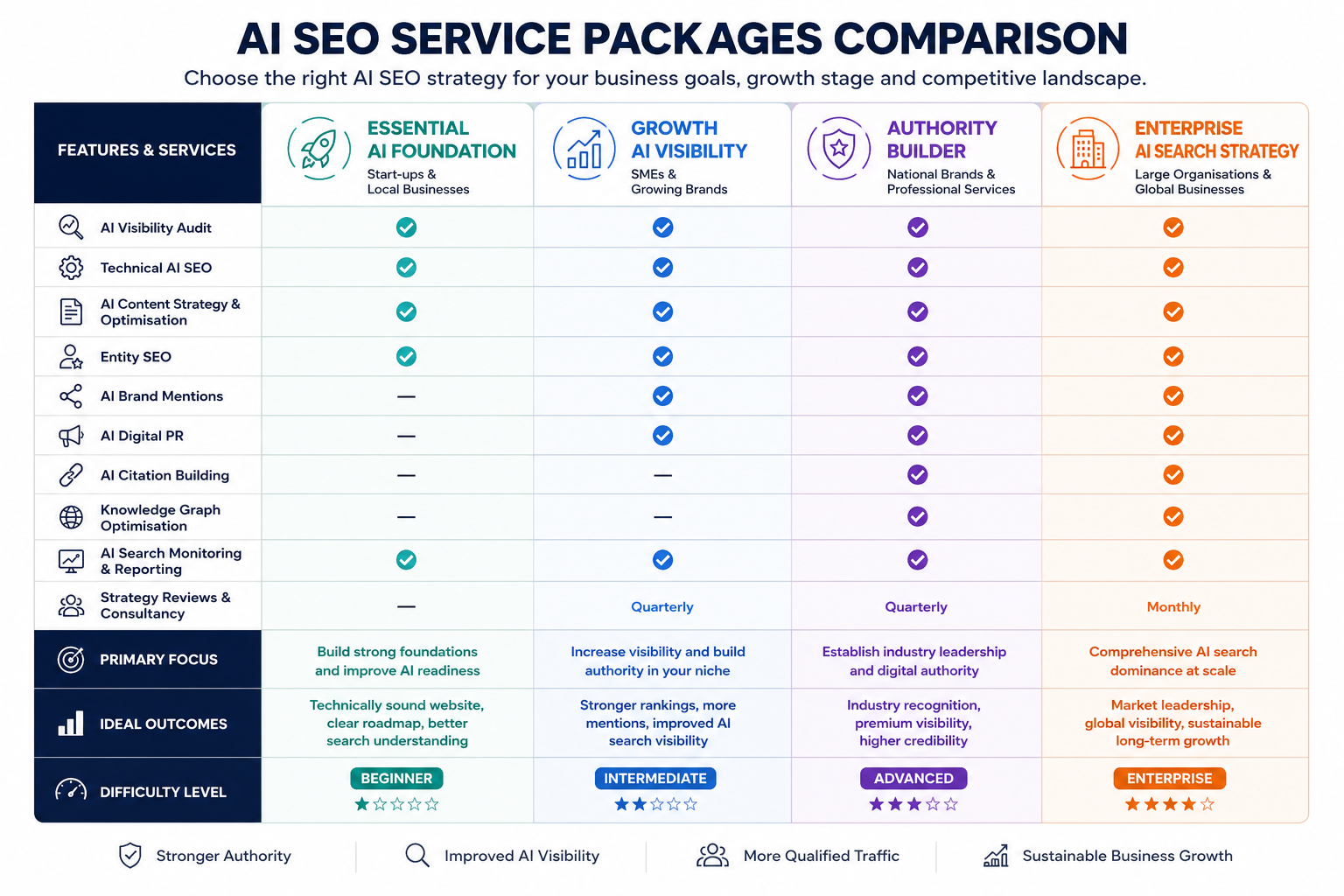
Which Investment Level Is Right for Your Business?
No two businesses have identical digital marketing requirements. A local accountancy practice, an ambitious SaaS company and an international eCommerce retailer will all require different levels of AI SEO support. Choosing the right combination of services is therefore more important than selecting the largest package.
The examples below illustrate how businesses at different stages of growth typically combine AI SEO services to build long-term visibility across both traditional search engines and AI-powered platforms. These are not fixed solutions but strategic frameworks that can be adapted to suit individual objectives, industries and budgets.
Our perspective
At Megrisoft, we don’t believe AI SEO is a completely new discipline. Instead, we see it as the natural evolution of modern SEO. Businesses that combine technical excellence, authoritative content, Digital PR, Entity SEO and AI Brand Mentions will be better positioned not only for today’s search engines but also for the AI-driven search experiences that are reshaping how people discover information online.
Frequently Asked Questions About AI SEO Services
1. What is AI SEO?
AI SEO is the practice of improving a website’s visibility across both traditional search engines and AI-powered search platforms. It combines technical SEO, content strategy, Entity SEO, Digital PR, AI Brand Mentions and Generative Engine Optimisation (GEO) to help businesses become more discoverable in AI-generated search experiences.
2. How is AI SEO different from traditional SEO?
Traditional SEO focuses primarily on improving rankings within search engine results pages. AI SEO builds upon these foundations by helping businesses appear in AI-generated answers, conversational search experiences and recommendation engines. It places greater emphasis on authority, entities, structured data and trusted editorial mentions.
3. Is AI SEO replacing traditional SEO?
No. AI SEO is not replacing traditional SEO; it is evolving it. Technical SEO, website performance and quality content remain fundamental, but businesses also need to optimise for AI-powered search platforms that interpret and recommend information differently.
4. What is AI Search Optimisation?
AI Search Optimisation is the strategic process of improving how a business is understood and recommended by AI-powered search platforms such as Google AI Overviews, ChatGPT, Gemini, Claude and Perplexity. It combines technical optimisation with authority building, structured data and high-quality content.
5. Does ChatGPT rank websites?
No. ChatGPT does not rank websites in the same way as a traditional search engine. Instead, it generates responses by interpreting information from available sources. Businesses cannot directly optimise for ChatGPT alone, but they can improve their overall digital authority and content quality, making them more likely to be referenced where applicable.
6. Can AI recommend my business?
Yes. AI-powered platforms can reference and recommend businesses when they have sufficient confidence in their expertise, authority and credibility. Strong technical SEO, authoritative content, structured data and trusted editorial mentions all contribute towards improving AI visibility.
7. What is Generative Engine Optimisation (GEO)?
Generative Engine Optimisation (GEO) focuses on creating content that is easier for AI-powered search engines to understand, interpret and reference within generated responses. GEO complements traditional SEO by preparing content for conversational search experiences.
8. What is Answer Engine Optimisation (AEO)?
Answer Engine Optimisation (AEO) helps businesses create content that directly answers users’ questions. It focuses on clear, structured and informative content that can appear within AI-generated answers, featured snippets and voice search results.
9. What is Entity SEO?
Entity SEO helps search engines and AI platforms understand your business as a recognised organisation rather than simply a collection of web pages. It strengthens brand identity by improving consistency, structured data and relationships between your business, services, people and topics.
10. What is AI Visibility?
AI Visibility refers to how frequently and accurately your business appears across AI-powered search experiences, including Google AI Overviews, ChatGPT, Gemini, Claude, Copilot and Perplexity. It is becoming an increasingly important measure of digital presence.
11. What are AI Brand Mentions?
AI Brand Mentions are references to your business across trusted websites, online publications and authoritative resources. These mentions help reinforce your expertise and can contribute towards stronger recognition across AI-powered search platforms.
12. What is an AI Visibility Audit?
An AI Visibility Audit evaluates how well your business is currently positioned for AI-powered search. It reviews technical SEO, structured data, editorial authority, content quality, entity optimisation and competitor performance to identify opportunities for improvement.
13. Why is structured data important for AI SEO?
Structured data helps search engines understand the meaning and relationships within your content. Whilst it does not guarantee AI visibility, it improves clarity and supports more accurate interpretation of your website.
14. Does Digital PR help AI SEO?
Yes. Digital PR helps businesses earn authoritative editorial mentions and trusted references across respected publications. These signals strengthen digital authority and support long-term visibility across both search engines and AI-powered search platforms.
15. How long does AI SEO take to deliver results?
AI SEO should be viewed as a long-term investment. Technical improvements may produce results within a few weeks, whilst building authority through content, Digital PR and AI Brand Mentions often takes several months. Sustainable visibility is achieved through continuous optimisation rather than quick fixes.
16. Is AI SEO suitable for small businesses?
Absolutely. Small businesses can benefit significantly from AI SEO by establishing expertise within their niche, creating helpful content and building authority through consistent digital signals. AI Search Optimisation is not limited to large enterprises.
17. What is the difference between AI SEO and AI-generated content?
AI SEO is a strategic marketing discipline focused on improving visibility across search and AI platforms. AI-generated content is simply one method of producing text. Effective AI SEO relies on expertise, technical optimisation and authority rather than automatically generated content alone.
18. Can AI SEO improve Google rankings?
Yes. Many AI SEO practices, including better technical SEO, stronger content, improved user experience and increased authority, can also contribute to stronger organic search performance. AI SEO complements rather than competes with traditional SEO.
19. How do I know if my business needs AI SEO?
If your customers use Google, ChatGPT, Gemini or other AI-powered tools to research products or services, AI SEO is becoming increasingly relevant. Businesses that invest early are better positioned to strengthen their authority and adapt as search continues to evolve.


 UK
UK 
 US
US  CANADA